

Coronado Bridge spanning San Diego Bay with downtown skyline.

Social Security: The Single Most Valuable Decision in Retirement

A plain-language guide to claiming strategies, spousal and survivor benefits, taxation of benefits, working while collecting, and what changed under the Social Security Fairness Act.

Educational content only. Hafnia Insurance Services does not perform Social Security claiming analyses, file claims on your behalf, or provide personalized claiming recommendations. Always consult ssa.gov and a qualified financial planner or CPA for your specific situation.

A Choice Worth Tens of Thousands of Dollars

Social Security is the only retirement income source that is guaranteed for life, adjusted for inflation, and paid by the federal government. For most retirees, it is the single largest financial asset they have — often worth more than their entire retirement portfolio when valued as a stream of inflation-adjusted lifetime payments.

The decision of when to claim is the most consequential choice you will make. The difference between claiming at 62 and claiming at 70 can be about 77% in the size of your monthly check — for the rest of your life, plus your surviving spouse's life. Spread over a 25- or 30-year retirement, that decision is often worth several hundred thousand dollars.

Because of how much is at stake, the rules deserve to be understood — not skimmed.
The Math, In Plain Language

Your Social Security retirement benefit is based on your 35 highest-earning years, indexed for wage inflation.

Three key terms:

  • AIME (Average Indexed Monthly Earnings): Your top 35 years of inflation-adjusted earnings, averaged into a monthly figure.
  • PIA (Primary Insurance Amount): The benefit you would receive if you claim at your Full Retirement Age. This is calculated by applying a progressive formula to your AIME — replacing 90% of the lowest portion, 32% of the middle portion, and 15% of the highest portion.
  • FRA (Full Retirement Age): The age at which you receive 100% of your PIA. As of 2026, FRA is age 67 for everyone newly claiming (anyone born 1960 or later).

If you worked fewer than 35 years, the missing years count as zeros in the average — which significantly reduces your benefit. Working an additional year late in your career (even part-time) can replace a zero or a low-earning year and meaningfully raise your check.

You can see your earnings record and projected benefit at ssa.gov by creating a my Social Security account. This is the single most useful five minutes you can spend on retirement planning.

The 62-to-70 Window

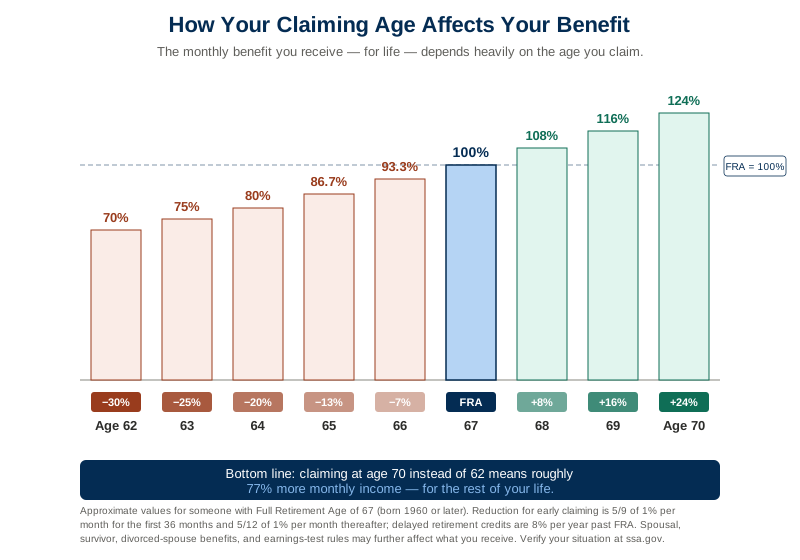
Chart showing Social Security benefit amount by claiming age (62–70)

You can claim Social Security retirement benefits as early as age 62 or as late as age 70. The earlier you claim, the smaller your monthly check — for life. The longer you delay (up to 70), the larger your monthly check — for life.

Approximate adjustment factors:

  • Age 62: Roughly 70% of your PIA (a 30% reduction for claiming 5 years early)
  • Age 67 (FRA): 100% of your PIA
  • Age 70: Roughly 124% of your PIA (delayed retirement credits of 8% per year past FRA)

The break-even age is generally somewhere between 78 and 82. If you live past that age, delaying claiming usually wins — sometimes by a wide margin. If you don't, claiming early usually wins. The problem, of course, is that no one knows in advance.

Variables that can shift the math:

  • Your health and family longevity. Women, in particular, have meaningfully longer life expectancies on average.
  • Whether you have a younger spouse. Delaying boosts not just your benefit but the survivor benefit your spouse may eventually receive.
  • Whether you're still working. Working past 60 may replace zero years and increase your PIA itself.
  • Whether you have other income to live on while delaying.
  • Your tax situation. Claiming benefits creates taxable income; delaying gives you more years for Roth conversions and other tax planning before SS starts.
This is the kind of decision a financial planner runs claiming-software analyses on. We are not those advisors. We can help you understand the framework. The decision belongs to you and your planner.

When You Can Claim on Your Spouse's Record

A spouse can claim a benefit equal to up to 50% of the higher-earning spouse's PIA, provided certain conditions are met:

  • The lower-earning spouse must be at least 62.
  • The higher-earning spouse must have already filed for their own benefit.
  • The lower-earning spouse must be married for at least 1 year before filing (with some exceptions).

Important nuances:

  • The 50% spousal benefit is calculated based on the higher earner's PIA, not their actual benefit. Even if the higher earner delays to 70, the spousal benefit does not grow past 50% of PIA.
  • Claiming a spousal benefit before your own FRA reduces it. A spousal benefit claimed at 62 is only about 32.5% of the higher earner's PIA, not 50%.
  • You cannot collect both your own benefit and a full spousal benefit. Social Security pays the higher of the two.

Divorced Spouse Benefits

If you were married for at least 10 years and are now divorced (and unremarried), you may be eligible to claim spousal benefits on your ex-spouse's record — and your ex-spouse is not notified and their benefit is not affected. You and your ex must both be at least 62, and you must have been divorced for at least 2 years (or your ex must have already filed).

What Happens When a Spouse Passes Away

Survivor benefits are often the most overlooked piece of the Social Security puzzle — and the most consequential.

When one spouse passes away, the surviving spouse keeps the larger of the two benefits, and the smaller benefit ends. There is no "double" payment to a survivor.

This is why delaying claiming (especially for the higher earner) is often a survivor benefit decision as much as a personal benefit decision. The higher earner's larger check will follow the lower earner for the rest of their life.

A few rules:

  • Earliest age to claim survivor benefits: 60 (50 if disabled).
  • Survivor benefit at FRA equals 100% of what the deceased was receiving (or would have been entitled to).
  • Claiming a survivor benefit early reduces it to as little as 71.5% of the underlying amount.
  • Surviving spouses can switch strategies. It is sometimes optimal to claim a reduced survivor benefit early and switch to your own delayed benefit at 70 — or the reverse. This is one of the most complex SS planning conversations and is best handled with claiming software.
  • Remarriage before age 60 generally ends survivor benefit eligibility. Remarriage at or after 60 does not.

The Earnings Test

If you claim Social Security before your Full Retirement Age and continue to work, your benefits may be temporarily reduced.

For 2026:

  • Before the year you reach FRA: You can earn up to $24,480 per year before SSA begins withholding $1 in benefits for every $2 earned above the limit.
  • In the year you reach FRA (but before your birthday month): A higher limit applies (about $65,000 in 2026, indexed annually) and the withholding ratio drops to $1 for every $3 earned over the limit.
  • At or after FRA: No earnings limit. You can earn any amount with zero impact on your benefit.

A widely misunderstood fact: the earnings test is not a permanent loss. Benefits withheld due to the earnings test are added back to your monthly benefit once you reach FRA, in the form of a recalculated higher benefit. The earnings test is more of a deferral than a tax.

That said, for many people the simplest answer is: if you plan to keep working, consider waiting at least until FRA to claim.

Up to 85% of Your Social Security May Be Taxable

Social Security benefits are subject to federal income tax depending on your "combined income" (also called provisional income), which equals:

Your adjusted gross income + nontaxable interest + ½ of your Social Security benefits

Tiers (these thresholds are not indexed and have not changed since 1993):

  • Single, combined income under $25,000 / Joint under $32,000: No tax on benefits.
  • Single $25,000–$34,000 / Joint $32,000–$44,000: Up to 50% of benefits may be taxable.
  • Single above $34,000 / Joint above $44,000: Up to 85% of benefits may be taxable.

Because these thresholds are not indexed to inflation, more retirees fall into the taxable zone every year. This is sometimes called the Social Security tax torpedo.

California-specific note: California does not tax Social Security benefits at the state level. Many of our clients moving to or from other states are surprised by this.

This is one of the reasons Roth conversions and tax-advantaged accumulation strategies matter — money pulled from a Roth IRA does not count toward combined income and therefore does not push more of your Social Security into the taxable zone. See our Roth Conversions page for more.

The Social Security Fairness Act and 2026 COLA

WEP and GPO Have Been Repealed

On January 5, 2025, the Social Security Fairness Act was signed into law, repealing two long-standing provisions:

  • The Windfall Elimination Provision (WEP) previously reduced Social Security benefits for retirees who also received a pension from a job that did not pay into Social Security (commonly: certain teachers, police officers, firefighters, and federal employees under the older Civil Service Retirement System).
  • The Government Pension Offset (GPO) previously reduced spousal and survivor benefits for the same group.

The repeal is retroactive to January 2024. SSA began issuing one-time back-payments in early 2025 and adjusted ongoing monthly benefits. If you or a spouse fell under WEP or GPO previously, your benefit should now reflect the full amount earned. If you previously did not file because you were told your benefit would be reduced to zero, you may want to file now.

2026 Cost-of-Living Adjustment

The 2026 COLA is 2.8%, applied beginning with January 2026 benefit payments.

2026 Earnings Test Limits

  • Under FRA: $24,480 before the $1-for-$2 reduction begins.
  • Year of reaching FRA (before birth month): higher limit applies, $1-for-$3 reduction.

2026 Maximum Wage Base

The maximum annual earnings subject to Social Security tax in 2026 is approximately $184,500. Earnings above that are not subject to the 6.2% OASDI tax (though the 1.45% Medicare tax has no cap).

Long-Term Solvency

The Social Security Trustees currently project that the combined retirement and disability trust funds will be depleted around 2034, after which incoming payroll taxes would still cover roughly 80% of scheduled benefits unless Congress acts. This is a real concern but does not mean benefits stop.

A Foundation, Not a Plan

Social Security is the foundation of most American retirement income — but for most people, it is not enough by itself.

The replacement rate (the percentage of pre-retirement income replaced by Social Security) is roughly:

  • About 40% for an average earner.
  • About 27% for someone earning at the maximum taxable wage.
  • Lower if you claim early; higher if you delay.

That leaves a meaningful gap that has to be filled from somewhere — typically from a 401(k), IRA, pension, taxable savings, real estate, business income, or fixed insurance products.

Where We Sometimes Help

Hafnia Insurance Services does not provide Social Security claiming advice, run claiming-software analyses, or file claims on your behalf. Those are conversations to have with ssa.gov, your CPA, or your financial planner.

Where we sometimes come in:

Bridge income for delayed claiming. If your plan calls for waiting until 70 to claim Social Security but you want to retire at 65, you need a way to pay yourself for those 5 years. Some clients use a fixed indexed annuity with a lifetime income rider to provide that bridge — generating a predictable income stream from 65 to 70 (and beyond, if desired) subject to the rider's terms and the carrier's claims-paying ability, while their Social Security benefit grows by 8% per year through delayed retirement credits.

Lifetime income alongside Social Security. Most workers no longer have an employer pension. A fixed indexed annuity with an income rider can give you a second guaranteed income stream for life, subject to the rider's terms and cost and the carrier's claims-paying ability.

Survivor income protection. Because Social Security drops to a single benefit when one spouse passes, some clients use indexed universal life insurance to ensure the surviving spouse has additional tax-advantaged income to replace the lost SS check.

These are tools — not a strategy on their own. The right decision starts with understanding your Social Security claiming options and only then asking whether and how an insurance product might fit alongside them.

Schedule a Discovery Call →

Common Questions

There is no universal answer. The factors that matter most are your health and family longevity, whether you're still working, whether you have a younger spouse, and whether you have other income to live on while delaying. Run the numbers in claiming software with a financial planner before deciding.
The trust fund is projected to be depleted around 2034, but Social Security is not going to "run out." Once the trust fund is depleted, incoming payroll taxes alone would still cover approximately 80% of scheduled benefits. Congress has a strong political incentive to act before that point — historically, it has, including in 1983.
No. You can file at any month between 62 and 70. Each month you delay between FRA and 70 adds approximately 0.67% to your benefit (about 8% per year). Each month you claim before FRA reduces your benefit.
Medicare enrollment is separate from Social Security claiming and has its own deadlines. You generally must enroll in Medicare Part A and B during your Initial Enrollment Period (the 7 months around your 65th birthday) to avoid lifetime late-enrollment penalties — even if you're delaying Social Security. See our Medicare page for more.
No. California does not tax Social Security benefits at the state level. They may still be subject to federal tax depending on your combined income.
You don't need their cooperation. You can apply for divorced-spouse benefits at any SSA office or online if you were married at least 10 years, are 62 or older, and have been divorced for at least 2 years (or your ex has filed). Your ex is not notified and their benefit is not reduced.
Yes. With the Social Security Fairness Act, GPO no longer applies. If you were previously told your benefit would be zero and therefore did not file, you may want to file now. Retroactive payments may be limited, so don't delay further.

Primary Sources

Social Security rules are complex and subject to legislative change. For the most current information:

  • ssa.gov — official Social Security Administration website
  • my Social Security account at ssa.gov — your personal earnings record and benefit estimate
  • ssa.gov/benefits/retirement/social-security-fairness-act.html — official guidance on the WEP/GPO repeal
  • ssa.gov/oact/cola — annual COLA, earnings test limits, and wage base announcements

If anything you read here conflicts with ssa.gov, ssa.gov wins. Tell us — we'll fix it.

San Diego harbor

Ready to Talk About How the Pieces Fit?

Once you understand your Social Security claiming options, the next question is what to do about the income gap between Social Security and the retirement you actually want. If a fixed insurance solution might be one piece of that answer, we're glad to walk through your situation in a 30-minute call. No cost. No pressure. No obligation.