

San Diego landscape representing long-term security and legacy planning.

Permanent Life Insurance with a Death Benefit and Index-Linked Cash Value.

Indexed universal life insurance combines a death benefit for your family with cash value that can grow based on the performance of a market index — with cash value protected against market-related index losses, subject to policy charges and fees.

Permanent Protection With Growth Potential

Indexed Universal Life (IUL) is a type of permanent life insurance with two core components:

  • A Death Benefit — paid to your beneficiaries income-tax-free upon your death
  • A Cash Value Account — that accumulates based on index performance, with a floor protecting against direct index losses

Unlike a term policy, IUL doesn't expire after 10 or 20 years — it remains in force for the rest of your life as long as the policy is properly funded. Unlike a whole life policy with guaranteed crediting, IUL ties its cash value growth to the performance of an external index (such as the S&P 500), subject to a cap and floor.
IUL two-bucket diagram: death benefit and cash value

Index Linking, Floors, and Caps — in Plain Language

You Pay Premiums

Premiums are flexible — you can overfund the policy to build cash value quickly, or pay a lower amount to keep it in force. Overfunding is subject to IRS rules (TEFRA/DEFRA) to maintain favorable tax treatment.

Cash Value Earns Index Credits

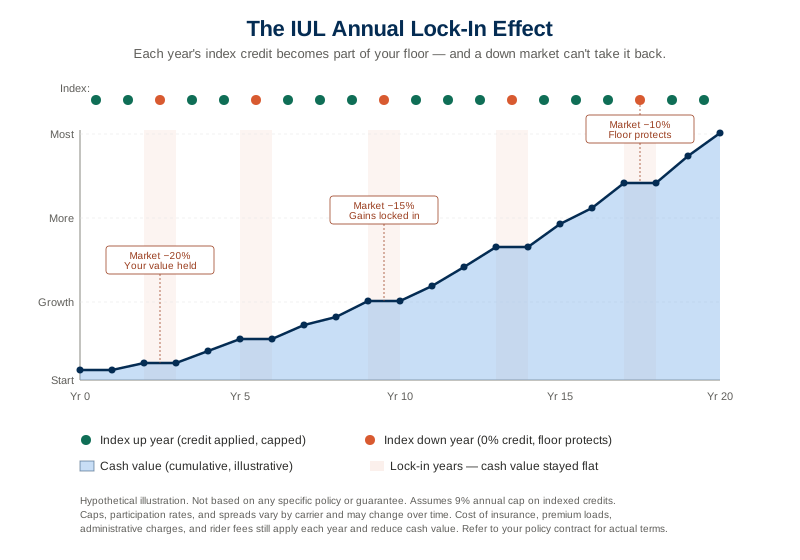
The carrier credits interest to your cash value based on how an external index (commonly the S&P 500) performs during a given crediting period — subject to a cap (upside limit) and floor (typically 0%). When the index is negative, you are credited 0%, not a loss.

Borrow or Withdraw Tax-Advantaged Cash

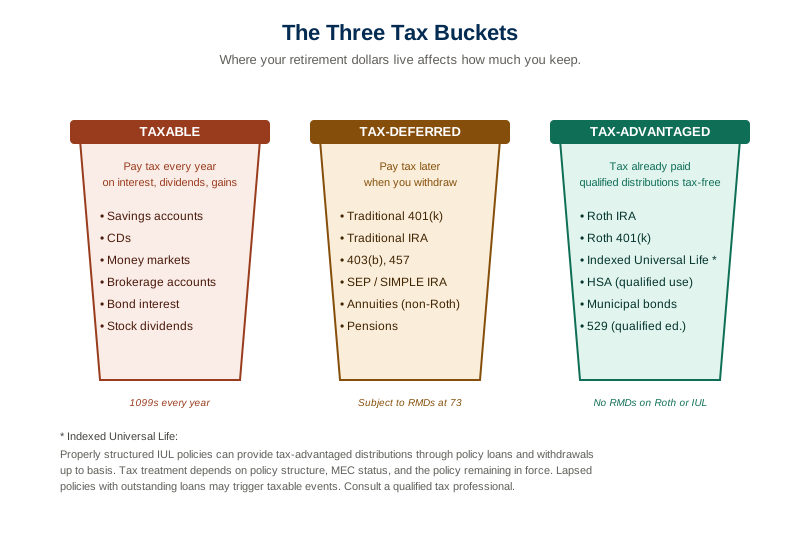
Properly structured IUL policies allow policy loans and withdrawals that, up to your basis, can be tax-free. Policy loans are generally income-tax-free but accrue interest and can reduce the death benefit if not repaid.

Important: These tax advantages depend on the policy remaining in force and not becoming a Modified Endowment Contract (MEC). Policy lapse, significant over-withdrawal, or loss of MEC-compliance can trigger tax consequences. Always consult a qualified tax professional.

Four Ways Our Clients Use IUL

Tax-Advantaged Accumulation

Premium dollars grow tax-deferred with index-linked crediting. Unlike a brokerage account or traditional IRA, properly structured IUL cash value grows without generating annual taxable income.

Supplemental Retirement Income

Policy loans taken in retirement can supplement other income without triggering income tax, subject to proper policy management and current tax law. Often used to bridge gaps between retirement and Social Security or pension start dates.

Legacy & Estate Planning

The death benefit passes to beneficiaries income-tax-free and outside of probate, making IUL a tool for efficiently transferring wealth. Some policies can be structured inside a trust for estate planning purposes.

Business and Family Protection

In addition to retirement planning, IUL's death benefit provides income-replacement protection for a spouse or dependents in the event of your death — a key function that other accumulation vehicles cannot provide.
How Does IUL Compare?

Comparison table: IUL vs Term Life vs Whole Life — showing permanent coverage, cash value, index crediting, and flexibility.

This comparison is for educational purposes only. The best life insurance product depends entirely on your financial situation, health, time horizon, and goals.

What to Understand Before Considering IUL

Cost of insurance increases with age: Internal policy charges rise as you get older. A policy that is underfunded, or that experiences extended periods of low index credits, can lapse.
Policy expenses: Premium loads, administrative charges, and rider fees reduce the amount that goes toward cash value, especially in the early years.
Surrender charges: Most IUL policies have surrender charges during the first 10–15 years. Withdrawing more than the available cash surrender value during this period can significantly reduce — or eliminate — what you receive.
Caps, participation rates, and spreads: These limit the index gains credited to your cash value. Carriers can change them within contractual ranges over time, often with limited advance notice.
Loans reduce the death benefit: Outstanding policy loans and accrued loan interest are subtracted from the death benefit paid to beneficiaries.
A lapsed policy with outstanding loans can trigger a taxable event: If a policy with significant loans terminates, the IRS may treat the gain portion as ordinary income.
MEC rules: Overfunding a policy beyond IRS limits classifies it as a Modified Endowment Contract, which changes the tax treatment of withdrawals and loans.
Tax treatment of withdrawals and surrender: Withdrawals beyond your basis (premiums paid) are generally taxed as ordinary income. Surrendering a policy with a gain triggers a taxable event and 1099 reporting. Withdrawals during early policy years may also incur surrender charges that further reduce what you receive.
Carrier strength matters: All policy guarantees are backed by the financial strength and claims-paying ability of the issuing insurance carrier.
IUL is a long-term commitment. It requires consistent funding and periodic review. We walk through every one of these factors with you, in writing, before any recommendation.

How We Help

1

Discovery Conversation

We discuss your income needs, existing protection, estate goals, and whether IUL's tax-advantaged accumulation makes sense for your situation.

2

Carrier & Product Comparison

We illustrate policies from multiple carriers, running the numbers at conservative crediting rates to show realistic projections.

3

Application & Underwriting

We guide you through the application and underwriting process. We are transparent about health questions and what to expect.

4

Ongoing Policy Review

Annual reviews to ensure the policy remains on track — checking funding levels, cash value performance, and loan balances.

FAQ — Indexed Universal Life

The phrase "tax-free" is often misused in IUL marketing. Here is the accurate version: the **death benefit** is generally income-tax-free to beneficiaries. **Cash value growth** inside the policy is tax-deferred. **Policy loans and withdrawals up to your basis (the premiums you've paid)** can typically be received without ordinary income tax — but only if the policy remains in force, is not classified as a Modified Endowment Contract, and is structured appropriately. If a policy lapses with outstanding loans, the gain portion may be taxable. We use the term **tax-advantaged** rather than "tax-free" because it more accurately describes how IUL works.
Both can offer tax-advantaged retirement income. Differences include: a Roth has annual contribution limits and income limits to qualify; IUL does not have those limits, but it does include a cost of insurance and policy expenses. A Roth is purely a retirement account; IUL provides a death benefit in addition to cash value. A Roth offers full liquidity after age 59½ and the 5-year rule; IUL has surrender charges in early years and accesses cash value through loans and withdrawals. Many clients use both — they serve different roles.
Whole life cash value grows based on the carrier's general account (typically a fixed dividend), while IUL cash value growth is tied to an external index, with a floor on indexed losses and a cap on indexed gains. Whole life typically has more guaranteed elements; IUL typically has more upside potential and more variability.
That depends on how much cash value the policy has. If sufficient cash value exists to cover ongoing policy charges, the policy can continue. If not, the policy may lapse. This is why IUL requires consistent funding and periodic reviews.
The death benefit is generally received income-tax-free by beneficiaries. However, large policies may be subject to estate taxes depending on policy ownership and the size of your estate. Coordination with an estate attorney is recommended for large cases.
All policy guarantees are backed by the financial strength and claims-paying ability of the issuing carrier. We discuss carrier financial strength ratings (such as A.M. Best, S&P, and Moody's) as part of any product recommendation, and we focus on carriers we believe are well-positioned to honor their long-term obligations.
Yes. In California you can return an life insurance policy for a full refund during the free-look period printed in the contract — at least 10 days, and 30 days if you're 60 or older on the purchase date (Insurance Code §§10127.9 and 10127.10). Other states set their own periods. The exact terms are on your policy.
The insurance carrier pays us a commission when a contract is issued — you don't write us a check. That commission is built into how the carrier prices the product (its caps, participation rates, spreads and surrender-charge schedule), so it isn't free. If you'd like to know the commission on any product we recommend, ask and we'll tell you.
San Diego scene

Explore Whether IUL Fits Your Plan

A no-cost conversation to walk through your situation and honestly assess whether indexed universal life insurance is the right tool. We'll tell you if it isn't.