

Sunset Cliffs in San Diego representing stability and protection in retirement planning.

Principal Protection From Index Losses.
Interest Linked to an Index Retire with Confidence.

A fixed indexed annuity is a contract with an insurance carrier designed to help you accumulate retirement assets and generate dependable income — with principal protected from market-related index losses, subject to contract fees and surrender charges.

The Basics, in Plain Language

A fixed indexed annuity (FIA) is a long-term contract between you and an insurance carrier. You pay a premium — either as a single deposit or a series of payments — and the carrier credits interest based on the performance of an external market index (such as the S&P 500), subject to a cap, participation rate, or spread defined in your contract.

In exchange for accepting limits on the upside, you receive something the markets cannot offer: a contractual floor that protects your premium from index-related losses. When the index goes down, your contract value does not decline due to negative index performance. Fees, surrender charges, and rider costs may still reduce your contract value.
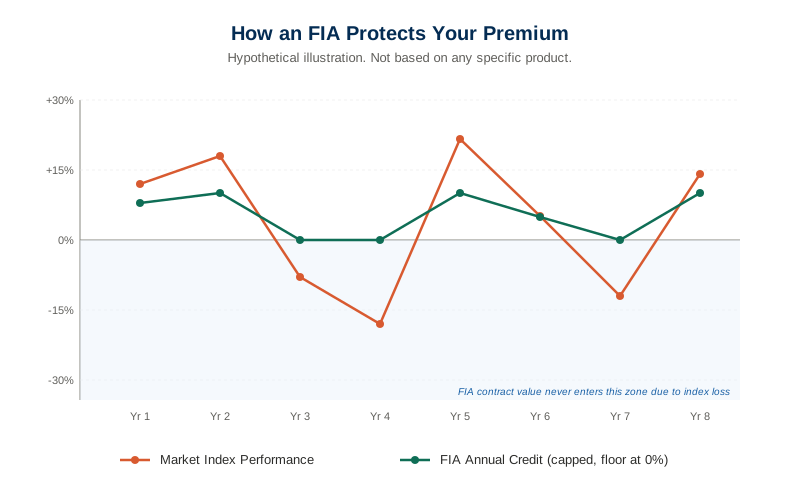
FIA floor diagram — showing how the 0% floor protects against index losses

Three Steps to Understanding Your Contract

1. You Fund the Contract

You move qualified or non-qualified dollars into the annuity as your premium. Common funding sources include 401(k) rollovers, IRA transfers, CDs, savings, or proceeds from another annuity (a 1035 exchange).

2. Your Premium Is Allocated

You choose from indexed crediting strategies (for example, an S&P 500 annual point-to-point) and/or a fixed account. Each strategy has its own cap, participation rate, or spread that defines how index gains are credited.

3. Your Contract Value Grows or Holds Steady

If the index is down, you are credited zero for that period — your contract value does not decline due to index loss. Contract fees, rider charges, and withdrawals can still reduce value.

FIAs are Most Often a Good Fit For:

  • Within 5–15 years of retirement, or already retired
  • Have money currently exposed to market risk they cannot afford to lose
  • Want growth potential without market downside on their premium
  • Need a reliable lifetime income stream they cannot outlive
  • Looking for tax-deferred accumulation
  • Don't need access to the full premium amount in the short term

FIAs are not designed for money you may need quickly, short-term goals, or anyone unwilling to accept surrender charges during the contract's early years.
Four FIA use case icons

Four Ways Our Clients Use FIAs

Protected Accumulation

Grow retirement assets with index-linked crediting and a contractual floor against index losses — especially in years leading up to retirement.

Guaranteed Lifetime Income

Optional income riders (for an additional fee) can provide a guaranteed income stream for life — even if the contract value runs out — subject to the rider's terms and carrier claims-paying ability.

RMD Planning

For qualified money, FIAs can be structured to support Required Minimum Distributions starting at age 73 (current law) without disrupting the contract's growth strategy on remaining funds.

Legacy Planning

FIAs typically pass to your named beneficiaries outside of probate. Some contracts include enhanced death benefit riders for an additional cost.

Things You Should Understand Before You Buy

We believe in showing both sides of every product. Before considering an FIA, you should understand:

Surrender charges: FIAs are long-term contracts. Withdrawals beyond the free withdrawal amount (commonly 10% per year) during the surrender period — typically 5 to 10 years, though some contracts extend longer — incur surrender charges that reduce your contract value.
Caps, participation rates, and spreads: These limit how much of the index's gain is credited to your contract. Carriers can change them within contractual ranges over time.
Index credits, not market returns: You are not invested in the index. You receive interest credits calculated using the index's performance and your strategy's terms.
Rider fees: Optional features like income riders or enhanced death benefits carry annual fees that reduce contract value.
Tax treatment: Withdrawals of taxable gains before age 59½ may be subject to a 10% IRS penalty in addition to ordinary income tax.
Carrier strength matters: All guarantees rest on the financial strength and claims-paying ability of the issuing insurance carrier.

We walk through every one of these with you before any recommendation — in writing.

How We Help

1

Discovery Call

A 30-minute conversation about your retirement goals, current accounts, income needs, and concerns.

2

Carrier & Product Comparison

We review FIA contracts from carriers we are appointed with and identify ones that may fit your situation — side by side.

3

Suitability & Best Interest Review

California's best-interest standard for annuity recommendations (Insurance Code §10509.910 et seq., in effect since January 1, 2025) requires us to document why a recommendation is in your best interest — for every client, at every age. California's senior-protection rules (§§785–789.10) add further duties when you're 65 or older. You get the analysis in writing.

4

Implementation & Service

We coordinate paperwork, funding, and carrier setup. After issue, annual reviews keep your strategy aligned with your goals.

FAQ — Fixed Indexed Annuities

No. Variable annuities are securities products with money invested directly in sub-accounts that can lose value. FIAs are fixed insurance contracts. Your premium is not invested in the market; index performance is used as a reference to calculate interest credits, with a contractual floor against index losses.
Your contract value will not decline due to negative index performance. However, contract fees, optional rider charges, and withdrawals can reduce your contract value. Surrender charges apply to early withdrawals beyond the free withdrawal amount.
FIAs typically have a surrender charge period of 5 to 10 years, though some contracts extend longer. During that time, you can usually withdraw up to 10% of the contract value annually without surrender charges. After the surrender period, you typically have full access.
The contract typically passes directly to your named beneficiaries, bypassing probate. Death benefit features vary by contract.
No. FIAs aren't bank products and aren't insured by the FDIC or any federal agency. Every guarantee in the contract is backed solely by the financial strength and claims-paying ability of the issuing insurance carrier — which is why we show you the carrier's current financial-strength rating before any recommendation.
Yes. In California you can return an annuity contract for a full refund during the free-look period printed in the contract — at least 10 days, and 30 days if you're 60 or older on the purchase date (Insurance Code §§10127.9 and 10127.10). Other states set their own periods. The exact terms are on your contract.
The insurance carrier pays us a commission when a contract is issued — you don't write us a check. That commission is built into how the carrier prices the product (its caps, participation rates, spreads and surrender-charge schedule), so it isn't free. If you'd like to know the commission on any product we recommend, ask and we'll tell you.
San Diego coastline

See Whether an FIA Fits Your Plan

A 30-minute, no-cost call to walk through your situation and explore whether a fixed indexed annuity makes sense for you. No pressure. No obligation.