Long-exposure detail of waves on the rocks at Sunset Cliffs, San Diego.

Long-Term Care: The Retirement Risk Most Plans Don't Address

A plain-language guide to who needs care, what it costs (especially in California), what Medicare does and does not cover, and the funding options that actually exist.

Educational content only. Long-term care insurance and hybrid policies are regulated by the California Department of Insurance. Hafnia Insurance Services does not provide legal advice on Medi-Cal eligibility, asset protection trusts, or estate planning — those conversations belong with a qualified elder-law attorney.

What "Long-Term Care" Actually Means

Long-term care (LTC) is the assistance someone needs when they can no longer perform basic daily activities on their own — not because of a single medical event, but because of chronic conditions, cognitive decline, or the cumulative effects of aging.

Care is generally triggered when a person needs help with at least two of the six Activities of Daily Living (ADLs):

  • Bathing
  • Dressing
  • Eating
  • Toileting
  • Transferring (getting in and out of bed or a chair)
  • Continence

Or when a person has a severe cognitive impairment (such as Alzheimer's or another form of dementia) requiring substantial supervision.

LTC is not the same as medical care. It's care for the activities of daily life — and that distinction matters because it determines who pays.

Care happens in different settings:

  • At home, provided by a family member or paid caregiver
  • Adult day care programs for daytime supervision
  • Assisted living communities for those who need help but don't require 24/7 medical care
  • Skilled nursing facilities (nursing homes) for the highest level of care

Most people experience care in more than one of these settings over the course of their care journey.

How Likely Is It That You'll Need Care?

You'll often see the statistic that "70% of people over 65 will need some form of long-term care." That number is technically correct, but it bundles together a wide range of situations — from a few weeks of home care after surgery, to several years of nursing home care.

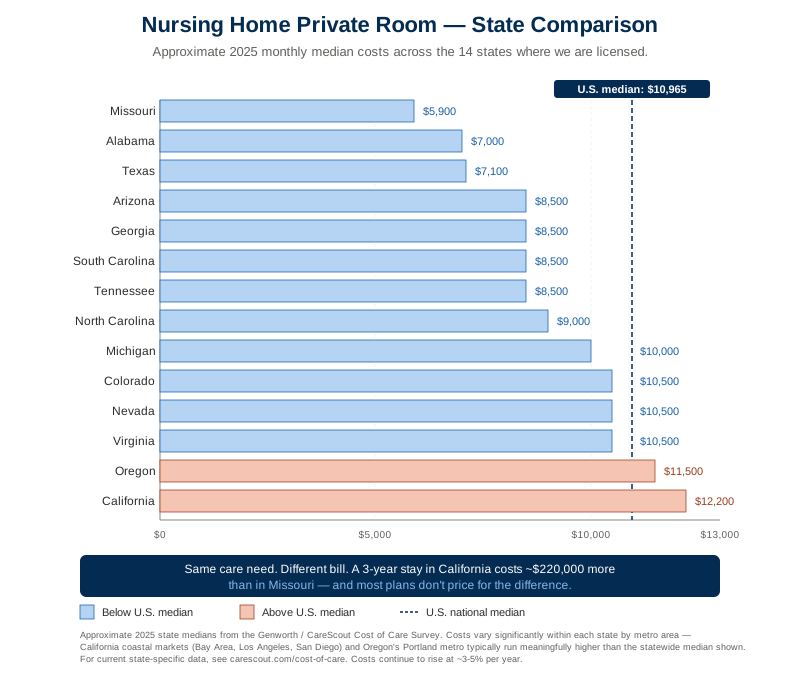
Long-term care probability and cost statistics across 14 states

What Actually Happens After Age 65:

14% Need 5+ Years Will need five or more years of paid long-term care.
22% Need 1 to 5 Years Will need between one and five years of paid care.
31% Need Under 1 Year Less than a year of paid care, or unpaid family care only.
33% Need No Care Will not require any long-term care assistance.

Figures drawn from HHS research and academic studies. Breakdown represents a working model.

Women Face Higher Risk on Average: They live longer, are more likely to develop dementia, and are also more likely to provide unpaid care to a spouse before facing their own care needs. Most LTC planning conversations should center on the female spouse's longevity scenario.

The risk is real and concentrated. A small share of people face very large bills; many face moderate bills; some face none. The challenge is that no one knows in advance which group they will be in — and the worst outcomes (5+ years of care) are concentrated in dementia cases, where stays can extend a decade or longer.

What Care Actually Costs in 2026

The most widely cited source for LTC cost data is the Genworth/CareScout Cost of Care Survey. Here are the most recent national median figures (2025 data, the latest available):

Care setting National median
Adult day care (5 days/week) ~$2,060/month ($24,700/year)
Home health aide (44 hours/week) ~$6,670/month ($80,080/year)
Assisted living (private apartment) ~$6,200/month ($74,400/year)
Memory care ~$7,750/month (about 25% above assisted living)
Nursing home, semi-private room ~$9,580/month ($114,975/year)
Nursing home, private room ~$10,800/month ($129,575/year)

California costs typically run higher than the national median, particularly in coastal metro areas. Recent California-specific medians have been roughly:

  • Assisted living (private apartment): $7,000/month, with Bay Area and coastal Southern California meaningfully higher
  • Nursing home (private room): $15,178/month
  • Home health aide: ~$110/hour (CareScout 2025), or roughly $7627/month at 44 hours/week

Costs continue to rise faster than general inflation — historically about 3.5–5% per year. If costs continue to rise at that historical pace, a nursing home that costs $11,000/month today would be roughly $13,000–$14,000/month in five years.

The average length of paid LTC is about 2.5 to 3 years. Many cases run shorter; dementia cases often run far longer.

The Most Common (and Most Expensive) Misconception

Many Americans assume Medicare will cover the cost of long-term care. It will not — at least not for most LTC.

Here's what Medicare actually covers and doesn't:

  • Medicare covers short-term, skilled rehabilitation in a skilled nursing facility — but only after a qualifying hospital stay, and only for up to 100 days, with cost-sharing after day 20.
  • Medicare does not cover custodial care — help with bathing, dressing, eating, etc. — which is what most long-term care actually is.
  • Medicare does not cover assisted living, memory care, or long-term nursing home stays.

This is a significant gap, and the misconception persists because Medicare does cover related-sounding services (hospital stays, skilled rehab, hospice, home health for medical reasons). Read the fine print: Medicare's home health benefit is for skilled medical care, not personal care assistance.

See medicare.gov for details on what is and is not covered.

Five Funding Paths

There are essentially five ways Americans pay for long-term care. Most families end up using a combination.

Path 1: Self-Pay (Out of Pocket)

Drawing from savings, retirement accounts, home equity, or family resources. This is how most LTC is currently funded in the United States. The math works for high-net-worth households; for everyone else, sustained care can deplete a retirement portfolio quickly.

Path 2: Medicaid (Medi-Cal in California)

Medi-Cal covers nursing home care for those who qualify, but qualification requires meeting strict income and asset limits. Most people must "spend down" their assets first — meaning they must use up most of their savings before the program pays.

A few important California-specific notes:

  • California's Medi-Cal asset limit is back. Between 2024 and 2025 there was no asset limit for most non-MAGI Medi-Cal programs. As of January 1, 2026, the limit is $130,000 for an individual, $195,000 for a couple and $65,000 for each additional household member (the home you live in, one vehicle and certain other property stay exempt). Transfer penalties also returned for people applying for nursing-home coverage on or after January 1, 2026, with a look-back of up to 30 months; transfers made during 2024 and 2025 aren't counted. The rules are detailed and still being implemented — always consult a California elder-law attorney before moving assets with Medi-Cal in mind, and check dhcs.ca.gov and canhr.org for current figures.
  • Estate recovery — after a Medi-Cal recipient passes away, the state may seek reimbursement from the estate for benefits paid. California's recovery rules were significantly limited in 2017, but this remains an evolving area.

Medi-Cal planning is a legal specialty. We can describe the general framework but cannot give you eligibility advice. Consult a California elder-law attorney before making any moves intended to qualify for Medi-Cal.

Path 3: Traditional Long-Term Care Insurance

A standalone insurance policy that pays a daily or monthly benefit for qualifying care, after a waiting period (called the "elimination period"). You pay annual premiums for life. If you never need care, the premiums are spent — there is no death benefit or return of premium.

  • Pros: Designed specifically for LTC. Can offer the most coverage per premium dollar. Tax-qualified policies offer some tax advantages.
  • Cons: Premiums are not guaranteed and have historically increased significantly. If you stop paying, coverage typically lapses with no recovered value. Medical underwriting is strict. Many carriers have exited the traditional LTC market.

Path 4: Hybrid Life Insurance + LTC

A permanent life insurance policy (often a fixed indexed universal life policy) with a long-term care or chronic illness rider. The death benefit can be accelerated to pay for qualifying LTC; if you never need care, the death benefit passes to your beneficiaries.

  • Pros: Many designs offer guaranteed level premiums (especially whole-life-chassis hybrids); some UL-chassis hybrids have a rising cost of insurance to be aware of. Death benefit is paid even if no LTC is used. Often more lenient underwriting than standalone LTC.
  • Cons: Requires a substantial commitment of premium dollars. The LTC benefit reduces the death benefit dollar-for-dollar. Two main rider types exist (7702(b) qualified LTC riders and 101(g) chronic illness riders), with different trigger requirements and tax treatment.

Path 5: Hybrid Annuity + LTC

A fixed or fixed indexed annuity with a long-term care benefit rider. The annuity provides a multiple of the account value (typically 2x or 3x) for qualifying LTC; if you never need care, the annuity remains as a retirement asset.

  • Pros: Often available with simplified medical underwriting (favorable for those who couldn't qualify for traditional LTC's full medical underwriting). Under the Pension Protection Act of 2006, qualifying LTC distributions from a properly structured annuity are received income-tax-free. Account value is preserved if care is never needed.
  • Cons: Requires a meaningful single premium (often $50,000+). Tying assets up in an annuity may not fit every situation. LTC benefit triggers and elimination periods vary widely by carrier.

Family Caregiving

The largest source of LTC in the United States is unpaid family care — typically provided by an adult daughter or daughter-in-law. While not a "funding source" in dollar terms, it has real costs: lost wages, reduced retirement savings, and physical/emotional strain on the caregiver. A realistic LTC plan accounts for whether (and for how long) family care is sustainable.


A State-Backed Asset-Protection Program Worth Knowing About

California is one of a handful of states with a Partnership for Long-Term Care program, which gives Californians who buy qualifying LTC insurance an additional layer of asset protection.

Here's how it works in plain language:

  • You purchase a Partnership-qualified LTC policy from an approved carrier.
  • If your benefits are exhausted and you eventually apply for Medi-Cal LTC benefits, the dollar amount of LTC insurance benefits you received is "protected" from Medi-Cal asset and estate recovery rules.
  • For example: if your Partnership policy paid out $300,000 in LTC benefits, you can keep $300,000 in additional assets and still qualify for Medi-Cal — and that $300,000 is protected from Medi-Cal estate recovery after your death.

This is meaningful for clients who want to combine private LTC insurance with eventual Medi-Cal coverage as a fallback. Not all LTC policies are Partnership-qualified; the program has specific requirements that the carrier must meet.

See rureadyca.org (California Department of Health Care Services, which administers the Partnership) for more.

How LTC Pays for Itself in Tax Terms

A few things worth understanding:

  • Qualifying LTC benefits are generally received income-tax-free. This applies to traditional LTC insurance, qualifying riders, and (under the Pension Protection Act of 2006) qualifying annuity LTC distributions.
  • Premiums for qualified LTC insurance may be deductible as a medical expense, subject to age-based caps and the standard medical-expense deduction floor.
  • Self-employed individuals may be able to deduct LTC premiums above the line.
  • Some health savings account (HSA) dollars can be used for qualifying LTC premiums.

These are all situation-dependent. We don't run the tax math — your CPA does.

Where We Sometimes Help

Hafnia Insurance Services is a fixed-insurance practice. When long-term care coverage is the right tool,we refer you to a specialist in long-term care insurance and work alongside them

Indexed universal life policies with chronic illness or LTC riders.

These can serve dual purposes: a tax-advantaged accumulation vehicle and a source of LTC funding if the need arises. Best suited for clients who already want permanent life insurance and who would benefit from adding LTC protection at the same time.

Fixed annuities with LTC enhancement riders.

These can be especially appropriate for clients who:

  • Have funds they'd otherwise hold in CDs, savings, or non-qualified accounts
  • Want LTC protection but couldn't qualify for traditional LTC insurance medically
  • Want a fallback income or LTC benefit, but won't lose the principal if neither is needed

Coordinating LTC with Social Security and other retirement income.

A realistic LTC plan accounts for what other income would be available if a spouse needed extended care, and how LTC costs would be funded without depleting the surviving spouse's resources.

We do not sell standalone traditional LTC insurance. Carriers and design choices for traditional LTC are best served by a specialist; we'll happily refer you to one if a standalone policy is the right fit. We also do not provide Medi-Cal eligibility advice or estate planning legal services — those belong with an elder-law attorney.

The goal is the same regardless of which tool ends up being right: a plan that doesn't leave the well spouse impoverished if the other spouse needs years of care.

Schedule a Discovery Call →

Common Questions

Premium-wise, LTC products are typically most efficient when purchased between ages 50 and 65. Before 50, the cost is low but the time horizon is long. After 70, medical underwriting becomes harder and premiums rise sharply. Some hybrid annuity-based products can be purchased at older ages with simplified underwriting.
A 7702(b) LTC rider is regulated as long-term care insurance and requires a qualifying impairment expected to last at least 90 days, certified by a licensed health care practitioner. A 101(g) chronic illness rider is regulated as life insurance and typically requires a permanent or long-lasting impairment. Triggers, tax treatment, and underwriting differ. Both can pay for the same kinds of care; the right choice depends on your situation.
For most long-term care, no. Medicare covers up to 100 days of skilled rehab after a qualifying hospital stay, with cost-sharing after day 20. It does not cover custodial care, assisted living, or extended nursing home stays.
Veterans who served at least 90 days of active duty (with at least one day during a wartime period), require help with ADLs, and meet income/asset requirements may qualify for the Aid & Attendance benefit, which can cover a portion of LTC costs. Apply through VA.gov or with help from an accredited VA benefits attorney.
California's "spousal impoverishment" rules protect a portion of assets and income for the well spouse when the other spouse enters a nursing home and applies for Medi-Cal. The rules are complex and change periodically. Talk to an elder-law attorney before making any planning moves.
That depends on the product. Traditional LTC insurance is largely use-it-or-lose-it — if you never need care, the premiums are spent. Hybrid life and annuity policies are not — they preserve the underlying asset (death benefit or annuity value) if LTC is not used.
Traditional LTC carriers can — and historically have — raised premiums on in-force policies, sometimes substantially. Most state regulators require an actuarial filing before increases. California has rules limiting how and when increases can occur, but they cannot be ruled out. Many hybrid policy designs offer a guaranteed-level premium structure (especially whole-life-chassis hybrids), which is one reason they have grown in popularity. Premium structure varies by product — confirm in the specific contract.
That's a personal and legal decision, not a marketing one. The honest answer is: Medi-Cal LTC has real limitations on choice of facility, location, and care quality. Many families want better, but Medi-Cal is a critical safety net. The right plan is the one you can actually live with. Discuss with an elder-law attorney before making any spend-down moves.

Primary Sources

  • carescout.com/cost-of-care — Genworth/CareScout Cost of Care Survey (annual)
  • medicare.gov/what-medicare-covers/what-part-a-covers/skilled-nursing-facility-care — what Medicare actually covers
  • dhcs.ca.gov — California Department of Health Care Services (Medi-Cal)
  • rureadyca.org — California Department of Aging
  • caltcalliance.org — California Long-Term Care Insurance Educational Project
  • insurance.ca.gov — California Department of Insurance (LTC carrier filings, complaint records, rate increase histories)
  • VA.gov — Veterans Affairs benefits

If anything you read here conflicts with these primary sources, the primary source wins. Tell us — we'll fix it.

San Diego harbor

Ready to Sketch a Plan?

LTC planning isn't about scaring you into a product. It's about understanding what care actually costs, what's realistic for your situation, and which tools — if any — fit. A 30-minute call is the right place to start. No cost. No pressure. No obligation.