

San Diego downtown skyline at golden hour over San Diego Bay.

Roth IRA Conversions: When Paying Tax Now Saves You More Later

A plain-language guide to converting traditional IRA and pre-tax 401(k) dollars to Roth — when it makes sense, when it doesn't, and how the conversion ladder strategy works.

Educational content only. Hafnia Insurance Services is not a CPA, tax advisor, or investment adviser. Always consult a qualified tax professional before executing a Roth conversion strategy.

The Basic Idea

A Roth conversion is the process of moving money from a pre-tax retirement account — a traditional IRA, a 401(k), a 403(b), a SEP IRA, or a SIMPLE IRA — into a Roth IRA.

Three things happen when you convert:

  1. You pay ordinary income tax on the converted amount in the year of conversion. The converted dollars are added to your taxable income for that year and taxed at your marginal rate.
  2. The money lands in a Roth IRA. Once inside, it grows tax-deferred.
  3. Future qualified withdrawals are tax-free. That includes the original conversion amount and all future growth, provided the Roth IRA rules are followed.

In short: you trade a tax bill today for tax-free retirement income later. Whether that trade is a good one depends entirely on your tax situation now versus your tax situation in retirement.

There is no income limit on conversions. Anyone with a traditional IRA can convert, regardless of how much they earn.

Six Reasons People Convert to Roth

1. Lock In Today's Tax Rates

Many Americans expect federal tax rates to rise. Converting now pays the tax at known current rates rather than at unknown future rates.

2. Eliminate Future RMDs

Traditional IRAs require minimum distributions starting at age 73 (rising to 75 in 2033 under SECURE 2.0). Roth IRAs have no required minimum distributions during the original owner's lifetime. Converting reduces or eliminates future RMDs.

3. Avoid the Widow's Tax Trap

When one spouse passes away, the surviving spouse typically files as Single — at higher tax brackets — for the rest of their life. Converting before that happens reduces the impact.

4. Tax Diversification

Most retirees have only one tax bucket: tax-deferred. Building a tax-free bucket alongside it gives you flexibility to manage your taxable income year by year in retirement.

5. Estate Planning

Roth IRAs pass to non-spouse heirs tax-free under the 10-year rule. Heirs receiving traditional IRA dollars must withdraw the full balance within 10 years and pay ordinary income tax on every dollar. Converting can shift more of your legacy into a tax-free form.

6. Charitable Givers May Have Different Math

If you plan to give a substantial portion of your IRA to charity, conversion may not make sense — qualified charitable distributions from a traditional IRA can satisfy RMDs without ever being taxed. This is the kind of nuance that requires a CPA conversation, not a website article.

Two Different 5-Year Rules — Most People Confuse Them

Roth IRAs have two separate 5-year rules. They sound similar but they govern different things, and getting them wrong can trigger taxes and penalties.

Rule #1: The 5-Year Rule for Tax-Free Earnings

Your Roth IRA must be open for at least 5 tax years before you can withdraw earnings tax-free. The clock starts on January 1 of the tax year of your first contribution (or your first conversion if that came first).

Rule #2: The 5-Year Rule for Each Conversion

Each conversion has its own separate 5-year clock. If you withdraw converted dollars before that conversion's 5 years are up and you're under age 59½, you may owe a 10% penalty on the withdrawal — even though no income tax is due (because tax was already paid at conversion).

This is the rule that trips up the conversion ladder strategy. Plan accordingly.

After age 59½, the 10% early-withdrawal penalty no longer applies, and the per-conversion 5-year rule no longer matters for penalty purposes — but the original 5-year rule for earnings still applies until the Roth itself has been open 5 years.

See IRS Publication 590-B for the official rules.

How to Spread Conversions Across Multiple Years

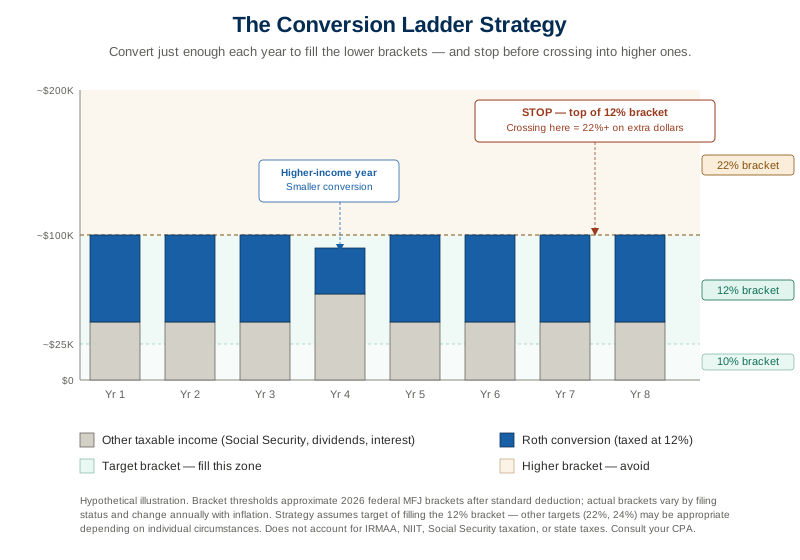
The conversion ladder is a strategy of converting a portion of your traditional IRA each year over a series of years, rather than all at once. The goal is to fill up the lower tax brackets without spilling into the higher ones.

A simplified example:

Suppose a married couple is retired, drawing modest income, and sits in the 12% federal tax bracket. Converting just enough each year to fill the 12% bracket (and stop before crossing into the 22% bracket) means every converted dollar is taxed at 12%. If they had instead converted everything in a single year, much of it would be taxed at 22%, 24%, 32%, or higher.

Done over 8 to 12 years, the ladder can move a substantial traditional IRA into Roth status while paying tax only at the bottom of your bracket structure each year.

The strategy requires careful coordination with your CPA. Variables that affect your conversion size each year include:

  • Your other taxable income (Social Security, pension, dividends, interest)
  • Capital gains realized during the year
  • Medicare IRMAA thresholds (more on this below)
  • The 3.8% Net Investment Income Tax threshold
  • State income tax rates
  • Whether you live in a state with no income tax (timing matters here)

We do not perform tax projections. Your CPA does. We can help you understand what role fixed insurance might play once dollars are converted — but the conversion math itself belongs in a tax professional's hands.

The Window from Retirement to Age 73

Chart showing the Roth conversion window between retirement and age 73

For many retirees, the years between their last paycheck and the start of RMDs are the lowest-income years of their adult lives — and therefore often the lowest-tax years.

This window is roughly:

  • Earliest start: Whenever you retire (often 60–65)
  • End: April 1 following the year you turn 73 (under current law)

During these years, you may have control over how much taxable income you generate. Your Social Security may not have started yet (if you're delaying to age 70). Your portfolio may be living off taxable accounts, leaving your IRA untouched.

That's the conversion sweet spot. Once RMDs begin, you no longer have full control — required distributions push your taxable income up whether you want them or not, and that often makes new conversions less efficient.

Two important coordinating considerations:

Medicare IRMAA. Once you're 63 or older, the income on your tax return affects your Medicare Part B and D premiums two years later. Large conversions can spike your IRMAA bracket and significantly increase Medicare premiums. Planning conversions around IRMAA thresholds is a meaningful piece of the math.

Social Security taxation. Up to 85% of your Social Security benefit can be taxable depending on your other income. Conversions can push more of your SS into the taxable zone, which is sometimes called the "tax torpedo."

Your CPA models these interactions. We don't.

Honest Trade-Offs

Roth conversions are not the right move for everyone. Before converting, you should understand:

  • The tax bill is real and immediate. Every dollar converted is added to your taxable income for that year. A large conversion can move you into a higher bracket, trigger additional Medicare premiums, increase Social Security taxation, and hit the 3.8% Net Investment Income Tax.
  • You should pay the tax with non-IRA money. Using IRA dollars to pay the conversion tax reduces the amount that ends up in the Roth — and if you're under 59½, the dollars used to pay tax may also be subject to a 10% penalty. Converting works best when you have outside cash to cover the tax.
  • The pro-rata rule applies if you have any non-deductible basis in your IRA. You cannot cherry-pick which dollars to convert; the IRS treats all your traditional IRAs as one big pool for conversion purposes. This is critical for backdoor Roth strategies.
  • Recharacterizations are no longer allowed. Once you convert, you cannot undo it. The Tax Cuts and Jobs Act of 2017 eliminated this option, so the decision needs to be right the first time.
  • State tax matters. Converting in a high-tax state right before moving to a no-tax state means you paid state tax on income you wouldn't have owed had you waited. Timing matters.
  • If you're already in retirement and your income is unusually low this year, that may be your best conversion year — but only your CPA can confirm.

Where We Come In — Carefully

Hafnia Insurance Services does not run the conversion math. We don't decide whether to convert, when to convert, or how much. That belongs to you and your CPA.

Where we sometimes help:

Once dollars are converted, they need to live somewhere. Some clients use fixed indexed annuities to hold Roth-converted dollars when they want:

  • Index-loss protection on the principal — during the 5-year waiting period and after — with index-linked interest potential, subject to contract fees and surrender charges
  • The option to convert the Roth balance into a guaranteed lifetime income stream later
  • A vehicle for holding Roth dollars; qualified Roth distributions remain tax-free regardless of the holding vehicle, and Roth IRAs do not require RMDs during the original owner's lifetime

This is one possible tool among many. A diversified portfolio of stocks and bonds inside a Roth — the kind your registered investment adviser would manage — is another. The right fit depends on your goals, risk tolerance, and the role this money plays in your overall retirement income plan.

If a Roth-funded fixed annuity is the right fit for one piece of your strategy, we can help with that piece. If it isn't, we'll tell you. Either way, the conversion decision itself is a tax conversation — and that conversation belongs with your CPA.

Schedule a Discovery Call →

Common Questions

Yes. There is no income limit on Roth conversions, even though there are income limits on direct Roth IRA contributions. (For 2026, direct Roth contributions phase out between $153,000–$168,000 for single filers and $242,000–$252,000 for joint filers, but conversions have no such cap.)
A backdoor Roth is when someone earning above the direct-contribution income limit makes a nondeductible contribution to a traditional IRA and then immediately converts it to Roth. The strategy is currently legal but is sensitive to the pro-rata rule. Talk to your CPA before attempting one.
No. Anyone with a traditional IRA can convert at any age. However, working-year conversions are often less efficient because your earned income already fills the lower brackets.
You can convert from a 401(k) by either (a) doing an in-plan Roth conversion if your plan allows it, or (b) rolling over to a traditional IRA first and then converting. Each path has different implications. Your plan administrator and your CPA need to weigh in.
No. You can convert any amount in any year. The conversion ladder strategy specifically uses partial conversions over many years.
No. Recharacterizations were eliminated by the Tax Cuts and Jobs Act of 2017. Once you convert, the conversion is permanent.
No. A conversion does not satisfy a required minimum distribution. If you are 73 or older, you must take your full RMD for the year before you convert any additional amount. Converting RMD dollars themselves is not allowed.
Many employer plans now offer a Roth 401(k) option, which receives after-tax contributions today, grows tax-deferred, and provides tax-free qualified withdrawals in the future. As of 2024, Roth 401(k)s no longer require RMDs during the owner's lifetime, aligning them with Roth IRAs.

Primary Sources

The IRS rules around Roth conversions, contribution limits, and RMDs change. We update this page when we notice changes, but for the most current rules:

  • IRS Publication 590-A: Contributions to Individual Retirement Arrangements
  • IRS Publication 590-B: Distributions from Individual Retirement Arrangements
  • irs.gov/retirement-plans

If anything you read here conflicts with a primary source, the primary source wins. Tell us — we'll fix it.

San Diego harbor

Have Questions About Where Roth Dollars Should Live?

Once your CPA helps you decide whether to convert, the next question is what those Roth dollars should do. If a fixed insurance solution might be one piece of that answer, we're glad to walk through your situation in a 30-minute call. No cost. No pressure. No obligation.