Hotel del Coronado, San Diego, the historic 1888 Victorian-style hotel under dramatic skies.

Legacy & Wealth Transfer: What Happens to Your Money After You're Gone

A plain-language guide to the documents, decisions, and tax rules that determine whether your legacy goes where you want it to go — efficiently and without family friction.

Educational content only. Estate planning involves drafting legal documents, which is the practice of law. Hafnia Insurance Services does not draft wills, trusts, or any other estate planning documents — that work belongs with a qualified California estate attorney.

What "Estate Planning" Actually Means

Most people think of estate planning as a tax-avoidance exercise for the wealthy. With the federal estate tax exemption now at $15 million per person ($30 million for married couples) under the One Big Beautiful Bill Act, fewer than one in a thousand U.S. estates will owe federal estate tax. So if you're not in that group, do you still need to plan?

Yes — and the reasons have nothing to do with taxes.

Estate planning is really about three things:

  1. Control over what happens to your money. Without a plan, state law decides.
  2. Control over who makes decisions if you can't. Without documents, the court appoints someone — often a stranger.
  3. Reducing friction for your family. Without coordination, beneficiary disputes, probate delays, and tax surprises can stretch grief into years of administration.

A good estate plan is, fundamentally, an act of love and responsibility toward the people you leave behind. Done well, it's largely invisible — your wishes are carried out, your family knows what's expected of them, and the process moves with quiet efficiency. Done poorly (or not at all), it becomes the thing your family talks about for years.

The Five Core Documents

A complete personal estate plan typically includes five core documents. Yours may need more (especially if you own a business, have minor children, or have substantial assets), but these are the foundation:

1. Last Will and Testament

Directs who receives your probate assets after death and names guardians for minor children. A will alone does not avoid probate — it just tells the probate court what your wishes are. In California, where probate is notoriously expensive and slow, most people with substantial assets pair their will with a revocable living trust.

2. Revocable Living Trust

A legal entity you create during your lifetime to hold assets. Assets titled in the trust pass directly to beneficiaries upon death without going through probate. Revocable means you can change it, modify it, or revoke it entirely while you're alive. For most California households with real estate or investment accounts, a properly funded revocable trust is the single most important estate planning tool — and the most underused.

3. Durable Power of Attorney for Finances

Designates someone to manage your financial affairs if you become incapacitated. "Durable" means the document remains valid even if you lose mental capacity — which is precisely when it's needed. Without one, your family typically has to petition the court for a conservatorship, which is expensive, public, and slow.

4. Advance Healthcare Directive

Designates someone to make medical decisions for you if you can't, and (in most cases) documents your wishes about end-of-life care. California has its own statutory form. This is the document hospital staff will ask for.

5. Beneficiary Designations

Often overlooked but critically important: the beneficiary forms on your retirement accounts, life insurance, annuities, and "transfer-on-death" accounts override your will. We dedicate Section 7 to this because it is the single most common point of failure in otherwise good estate plans.

A California estate attorney drafts these documents — usually as a coordinated package — and walks you through funding the trust (titling assets correctly so the trust actually works as intended). This is not DIY territory. Online templates miss California-specific requirements, fail to account for community property rules, and routinely produce documents that don't function properly when needed.

Federal Estate Tax in 2026

Under the One Big Beautiful Bill Act (signed into law July 4, 2025), the federal estate and gift tax exemption was made permanent at significantly higher levels:

  • 2026 exemption: $15 million per individual, $30 million for married couples (with portability)
  • Top federal estate tax rate: 40% on amounts above the exemption
  • Indexed for inflation starting in 2027
  • Annual gift tax exclusion (2026): $19,000 per recipient ($38,000 for married couples splitting gifts)

A few important nuances:

  • Portability lets a surviving spouse inherit any unused federal exemption from the deceased spouse — but only if the executor files a federal estate tax return (Form 706) within the deadline, even if no tax is owed. This step is missed often.
  • The federal estate tax is calculated on gross estate value, including life insurance death benefits — unless the policy is owned by an Irrevocable Life Insurance Trust (ILIT) or a similar structure. For estates approaching the threshold, this matters.
  • The generation-skipping transfer (GST) tax applies separately to transfers to grandchildren and other "skip persons." The 2026 GST exemption is also $15 million per person.

For estates that may exceed the exemption — typically those with closely held businesses, concentrated stock positions, substantial real estate, or large retirement accounts — proactive planning with an estate attorney and CPA is essential. The exemption is permanent under current law, but Congress can amend tax law at any time. Plans designed around the assumption that "the exemption will always be this high" are taking on political risk that should at least be acknowledged.

California-Specific Considerations

No California Estate Tax

California voters eliminated the state estate tax in the 1980s, and California also imposes no inheritance tax on heirs. This is a meaningful advantage for California residents — many states do impose state estate or inheritance taxes with thresholds far below the federal level. (For example, Oregon's threshold is $1 million; Massachusetts is $2 million; New York's is approximately $7.35 million.)

Community Property and the Double Step-Up Basis

California is a community property state. Most assets acquired during marriage are owned 50/50 by the spouses, regardless of whose name is on the title. This has a significant tax implication at the death of the first spouse: the entire community property asset receives a step-up in basis (not just the deceased spouse's half), which can dramatically reduce capital gains tax for the surviving spouse.

For example: A couple bought a San Diego home in 1985 for $200,000; it's now worth $1.5 million. In a non-community-property state, only half of the home would receive a step-up at the first death, leaving $650,000 of unrealized gain on the surviving spouse's half. In California, the entire $1.5 million basis steps up at the first death — meaning the surviving spouse could sell the home immediately for $1.5 million with no taxable gain (any appreciation between the first death and a later sale would still be taxable).

California Probate Is Expensive

California probate is governed by Probate Code §10800-10810, which sets statutory fees based on the gross value of the probate estate (not net of debts or mortgages). Both the executor and the probate attorney are entitled to identical statutory fees, which scale roughly as:

  • 4% on the first $100,000
  • 3% on the next $100,000
  • 2% on the next $800,000
  • 1% on the next $9 million
  • 0.5% on the next $15 million

A $1 million gross probate estate in California (typical for a paid-off home plus some accounts) generates statutory fees of approximately $23,000 for the executor and $23,000 for the attorney — $46,000 total, before any extraordinary fees or costs. A $2 million gross estate generates roughly $66,000 in combined statutory fees.

These statutory fees are why California has the highest revocable-living-trust adoption rate in the country. A funded revocable trust avoids probate entirely — the trust's assets pass directly to beneficiaries under the trust's terms, without court involvement.

California Is a "Spousal Property Petition" State

For surviving spouses, California offers a streamlined "Spousal Property Petition" process for transferring community property at death — which can avoid full probate even without a trust in some circumstances. An estate attorney can advise whether this applies.


Step-Up in Basis at Death

When you die, most assets your heirs inherit receive a "step-up in basis" — meaning their cost basis is reset to the fair market value at your date of death. Any unrealized capital gains during your lifetime are effectively erased for income tax purposes.

Example: You bought stock for $50,000 in 1995. At your death in 2026, it's worth $300,000. Your heirs' basis becomes $300,000. If they sell it the next day for $300,000, they owe zero capital gains tax — even though $250,000 of gain accumulated during your lifetime.

What gets the step-up:

  • Taxable brokerage accounts (stocks, bonds, mutual funds)
  • Real estate
  • Privately held businesses
  • Personal property of value
  • Most assets held jointly with right of survivorship (with some nuances)

What does NOT get the step-up:

  • Traditional IRAs and 401(k)s (pre-tax retirement accounts) — these are "Income in Respect of a Decedent" (IRD), and beneficiaries owe ordinary income tax on withdrawals
  • Roth IRAs and Roth 401(k)s — they don't need a step-up because qualified withdrawals are already tax-free
  • Annuities (in most cases) — gains remain taxable to beneficiaries as ordinary income
  • 529 plans, HSAs (in most cases)

This distinction has significant planning implications. Two people each leaving $500,000 to their children — one in a taxable brokerage account, the other in a traditional IRA — are leaving very different amounts after tax. The brokerage account passes essentially tax-free; the IRA's full balance is eventually taxable to the beneficiary as ordinary income, often over a 10-year window.

The order in which you spend down accounts during retirement can therefore have legacy implications, not just income-tax implications. This is one reason coordinated planning between a CPA and a financial planner matters — the optimal withdrawal sequence for income tax may differ from the optimal sequence for legacy.

Beneficiary Designations Override Your Will

This is the section every adult should read carefully:

The beneficiary forms on your retirement accounts, life insurance policies, annuities, and transfer-on-death (TOD) brokerage accounts override what your will or trust says.

If your will leaves "everything equally to my three children" but your 401(k) beneficiary form names only your oldest child (because you filled out the form 25 years ago and never updated it), the 401(k) goes entirely to that one child. Your will has nothing to do with it. The 401(k) does not pass through probate at all — it goes directly to the beneficiary on the form.

This causes more family disputes than almost any other estate planning failure.

Common scenarios where this goes wrong:

  • Old beneficiary forms naming an ex-spouse. Surprisingly common — especially on retirement accounts from long-ago employers.
  • Beneficiary forms left blank. When no beneficiary is named, the asset usually defaults to the estate, which means it does pass through probate — but typically with worse tax consequences than a properly named beneficiary would have produced.
  • Naming "my estate" as beneficiary on a retirement account. This usually accelerates the income tax timeline for beneficiaries dramatically (often a 5-year drawdown rather than the favorable 10-year stretch for designated beneficiaries).
  • Failing to name contingent beneficiaries. If your primary beneficiary predeceases you and you didn't name a contingent, the asset typically defaults to the estate.
  • Naming minor children directly. Without a trust to receive the assets on the children's behalf, this typically forces the appointment of a court-supervised guardianship of the estate — a process most parents would not want.

What to do:

  1. Pull every beneficiary form on every retirement account, life insurance policy, annuity, and TOD-titled account. Many can now be checked online; some still require a phone call.
  2. Confirm the named beneficiaries (primary and contingent) match your current intent.
  3. Update them if anything has changed — marriage, divorce, birth of children, death of a beneficiary, change in family relationships.
  4. Re-check after every major life event — and at least every 5 years.

This exercise is one of the highest-leverage actions in estate planning. It costs nothing, takes a few hours, and can prevent significant family harm.

Trusts: The Short Version

"Trust" is one of the most-used and least-understood words in estate planning. There are dozens of trust types, but for personal estate planning, two categories dominate:

Revocable Living Trust

Created during your lifetime, fully under your control. You can modify, fund, defund, or revoke it. You're typically the trustee while you're alive. Upon your death, a successor trustee distributes assets according to the trust's terms, without probate. This is the workhorse of California estate planning for most middle- and upper-middle-class households.

Irrevocable Trust

Once created and funded, you generally cannot modify or revoke it. Assets transferred to an irrevocable trust are typically removed from your estate for federal estate tax purposes — which is why irrevocable trusts are the primary tool for estates approaching the federal exemption threshold. Common types:

  • Irrevocable Life Insurance Trust (ILIT): Owns a life insurance policy outside your estate. The death benefit pays to the trust, which then distributes to beneficiaries — without the death benefit being included in your taxable estate. Useful for estates approaching the federal exemption.
  • Spousal Lifetime Access Trust (SLAT): A spouse-funded irrevocable trust that allows the donor to indirectly benefit through the spouse beneficiary. Strategy popular among estates approaching the exemption who want to use their gift tax exemption now while preserving some access.
  • Charitable Remainder Trust (CRT) and Charitable Lead Trust (CLT): Tools that combine charitable giving with income or estate tax benefits.
  • Grantor Retained Annuity Trust (GRAT): Used to transfer appreciating assets out of an estate at minimal gift tax cost.

These are highly specialized vehicles that require careful drafting, ongoing administration, and tax filings. They are not for everyone. For most households, the revocable living trust + properly updated beneficiary designations covers 90% of the planning need.

Where Fixed Insurance Fits

Hafnia Insurance Services does not draft estate planning documents, advise on Medi-Cal eligibility, or provide estate tax projections. Those belong with your estate attorney and CPA.

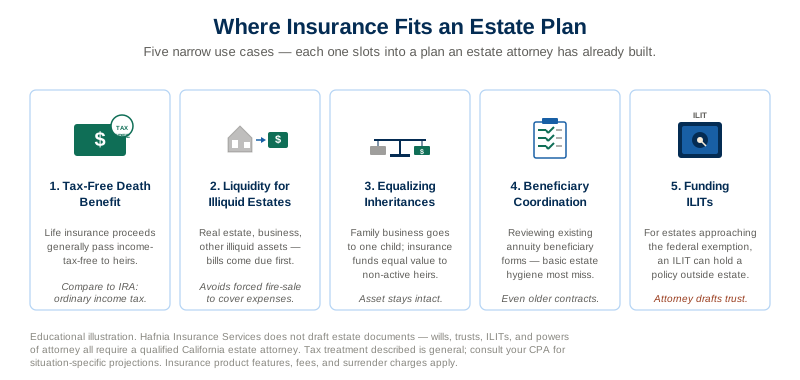
Where fixed insurance products can be one piece of an attorney-built estate plan:

Five use cases where life insurance and annuities support an estate plan: tax-free death benefit, liquidity, equalizing inheritances, beneficiary coordination, and funding ILITs

1. Income-Tax-Free Death Benefit

Life insurance death benefits are generally received by beneficiaries income-tax-free. For families looking to leave a meaningful legacy efficiently, life insurance can be among the most tax-efficient transfer mechanisms — particularly compared to leaving a traditional IRA, where beneficiaries owe ordinary income tax on withdrawals.

Example: In a 24% federal bracket scenario with no state tax, a $500,000 traditional IRA passing to a beneficiary delivers ~$380,000 after tax. A $500,000 life insurance death benefit delivers the full $500,000 income-tax-free.

2. Liquidity at Death for Illiquid Estates

Estates concentrated in real estate, closely held businesses, or other illiquid assets often face a problem at death: bills (estate taxes, debt, transition expenses) come due before the estate can be liquidated. Life insurance provides liquidity at exactly the moment it's needed — without forcing a fire sale of underlying assets.

3. Equalizing Inheritances

A family business or farm often goes to one child; the others may be entitled to equivalent value. Life insurance can fund the "equalization" share to non-active heirs, allowing the operating asset to pass intact to the active heir.

4. Beneficiary Coordination on Existing Annuities

Many retirees have older annuities — fixed, fixed indexed, or variable — with outdated beneficiary designations. Reviewing and updating these forms (and considering whether contract structures still serve their original purpose) is part of basic estate hygiene.

5. Funding Irrevocable Life Insurance Trusts (ILITs)

For estates approaching the federal exemption, an ILIT can hold a life insurance policy outside the taxable estate. The trust is drafted by an estate attorney; we work with the attorney to identify and structure an appropriate policy. We do not draft the trust.

What We Cannot Help With:

  • Drafting wills, trusts, powers of attorney, or healthcare directives
  • Advising on Medi-Cal eligibility, asset protection, or elder-law strategy
  • Estate tax projections or estate tax return preparation
  • Probate administration or trust administration

The right estate planning team is typically your CPA, a qualified California estate attorney, your financial planner, and (where appropriate) your insurance agent. We work alongside the attorney and CPA — never in place of them.

Common Questions

Yes. The federal exemption only matters for federal estate tax. Estate planning is mostly about control, family clarity, probate avoidance, and efficient asset transfer — none of which depend on whether you owe estate tax. In California, where probate is expensive, even modest estates benefit significantly from a revocable trust.
A will tells the probate court your wishes after death; assets still typically pass through probate. A revocable living trust holds assets during your lifetime and passes them to beneficiaries directly — without probate. Most California households with substantial assets use both: a "pour-over" will that catches anything not titled in the trust, plus a fully funded trust that holds the bulk of the estate.
You die "intestate." California intestacy law determines who inherits — typically a spouse and children in defined shares. The court appoints someone to administer the estate. If you have minor children and your spouse is also gone, the court appoints a guardian. None of these may match what you would have wanted.
At minimum, every 5-7 years. Update sooner after any of: marriage, divorce, birth or adoption of a child, death of a beneficiary, significant change in financial situation, move to a different state, or major change in tax law. The 2025 OBBBA was a major change in tax law — many older plans may need review.
They are subject to federal estate tax if you owned the policy at death — meaning the death benefit is included in your taxable estate. For estates well below the $15M exemption, this typically doesn't matter. For estates approaching or exceeding the exemption, an ILIT can remove the policy from the taxable estate. Income tax treatment is separate: death benefits are generally received income-tax-free regardless of estate tax treatment.
Since 2020, most non-spouse beneficiaries of retirement accounts must fully empty the inherited account within 10 years of the original owner's death. This significantly compressed the previous "stretch IRA" planning window. Surviving spouses, minor children of the deceased, and certain disabled or chronically ill beneficiaries follow different rules. See our Required Minimum Distributions page for the full picture.
Sometimes — but it's complicated. Naming a "see-through trust" can preserve favorable tax treatment for beneficiaries; naming the wrong type of trust can accelerate the income tax timeline dramatically. This is exactly the type of question that requires coordination between your estate attorney and CPA. Don't DIY this.
Sometimes called an "in terrorem" clause, it provides that any beneficiary who challenges the will or trust forfeits their inheritance. California enforces these clauses with significant restrictions. They can deter frivolous challenges but are not bulletproof. An attorney can advise whether one fits your situation.

Primary Sources

  • irs.gov/businesses/small-businesses-self-employed/estate-tax — Federal estate tax rules
  • irs.gov/forms-pubs/about-form-706 — Federal estate tax return (relevant for portability elections)
  • leginfo.legislature.ca.gov — California Probate Code (search §10800-10810 for statutory fees)
  • calbar.ca.gov — State Bar of California (find a qualified California estate attorney)
  • courts.ca.gov/8865.htm — California Courts probate self-help

If anything you read here conflicts with a primary source, the primary source wins. Tell us — we'll fix it.

San Diego harbor

Have a Plan? Want to Talk Through Where Insurance Might Fit?

The legal documents — wills, trusts, powers of attorney, healthcare directives — belong with your estate attorney. The insurance and annuity pieces are where we can help. Most prospects we meet already have an attorney; we work alongside them on the policy decisions that fit the plan they've built. A 30-minute call is the right starting point. No cost. No pressure. No obligation.